Hospital Acupuncture
Implementation Framework
Integrating acupuncture into hospitals is best understood as a process of service implementation. The Hospital Acupuncture Implementation Framework (HAIF) was developed to address this need, drawing on implementation science methodology and grounded in real-world experience from an acupressure project for post-operative nausea and vomiting (PONV). HAIF has since been applied to PANDA — Personalised Acupuncture in the Northern Hospital Emergency Department for Acute Pain. Current examples focus on the PONV project; information about PANDA will be updated here when available.

Phase 1: Exploration
Identifying human factors and environmental factors

Phase 2: Preparation
Addressing barriers and using enablers
Phase 3: Implementation
Executing with evidence-based strategies

Phase 4: Sustainment
Normalising into routine practice
Application Examples
Acupressure for PONV
Nurse-led acupressure wristband implementation for post-operative nausea and vomiting at Northern Hospital, Victoria.
View case study →PANDA — Acupuncture in the ED Coming Soon
Personalised Acupuncture in the Northern Hospital Emergency Department for Acute Pain. Research in progress.
Key Evidence
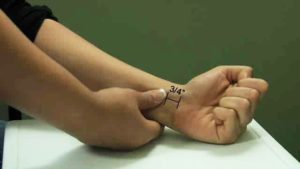
PC6 acupoint stimulation consistently reduces post-operative nausea and vomiting. Pooled across all modalities, nausea is reduced from 47% to 31% (RR 0.68, 95% CI 0.60–0.77), vomiting from 33% to 19% (RR 0.60, 95% CI 0.51–0.71), and rescue antiemetic use from 33% to 20% (RR 0.64, 95% CI 0.55–0.73).
Source: Lee et al., 2025 (Cochrane review update). Full evidence summaries →
About the Framework
HAIF is a collaborative innovation between RMIT University and Northern Health, led by Professor Zhen Zheng, PhD. It was developed during Professor Zheng's NHMRC Translating Research into Practice (TRIP) Fellowship (App 1110446), drawing on implementation science and hands-on experience from an acupressure project for post-operative nausea and vomiting (PONV). HAIF has since been applied to PANDA, implementing acupuncture in the Northern Hospital emergency department for acute pain.
Learn more about HAIF →